Hedge Bindweed Plant Health Benefits
Contents
Johan Kunzle wrote about the hedge bindweed plant: “We have to give Thanks to God since He literally put at our feet such a precious remedy as this.”
Healing Properties and Indications
All parts of this plant, especially the root, contain tannin and a resinous glycoside (convolvuline), similar in chemical composition and properties to that obtained from the jalap root. It has purgative, cholagogue, and choleretic properties.
- As a laxative, it acts energetically but does not produce irritation or vomiting. It is recommended for acute constipation. This plant can be administered to children.
- As a cholagogue, it eases the evacuation of the bile and is recommended for liver inflammation or congestion and in disorders relative to gall bladder emptying.
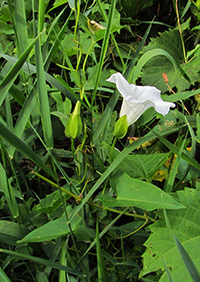
Field Bindweed
Field bindweed (Convolvulus arvensis L.) is smaller (as its name says) than greater bindweed; however, it has practically the same properties.
Palo de Rosa
In the Canary Islands, two endemic species of the convolvulus genus are locally called Palo de rosa (Convolvulus floridus L.). The essence obtained from their roots has practically the same medicinal properties as those of the hedge bindweed plant.
Hedge Bindweed Plant Scientific Facts
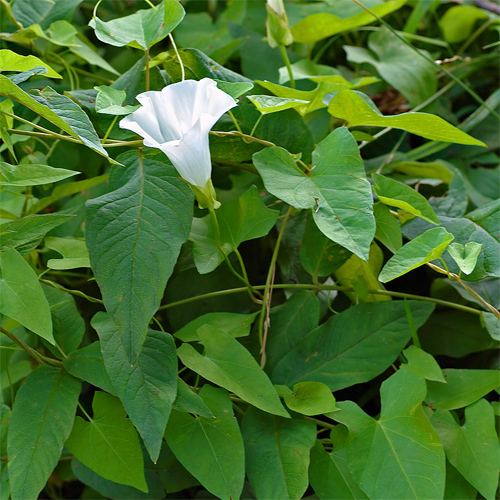
- Scientific synonyms: Convolvulus sepium L.
- Other names: Devil’s vine, great bindweed, hedge lily, Lady’s night-cap, rutland beauty, trailing bindweed, lesser bindweed.
- French: Liseron.
- Spanish: Correhuela mayor.
- Environment: Very common in bushes and boundaries all over Europe and America.
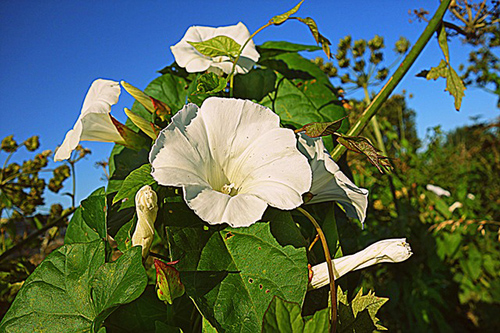
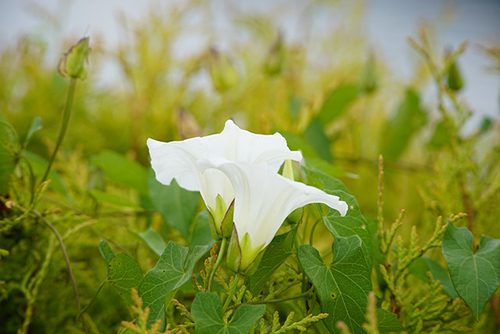
- Description: This is a vigorous climbing plant of the Convolvulusaceae family whose stems grow to 2.5 m long. It has heart-shaped leaves, and its flowers are large and pure white.
- Parts of the plant used medicinally: The root and the leaves.
How to use Hedge Bindweed
- Infusion with a spoonful of ground root or leaves per cup of water. Drink up to three cups daily, sweetened with honey.
- Powder. The usual dose is 1-3 g, distributed into three daily intakes.
DISCLAIMER: All content on this website is presented solely for educational and informational objectives. Do not rely on the information provided as a replacement for advice, diagnosis, or treatment from a qualified medical expert. If you are pregnant, nursing, or have any preexisting medical concerns, talk to your doctor before using any herbal or natural medicines.
REFERENCES
- George D. Pamplona-Roger, M.D. “Encyclopedia of Medicinal Plants.” George D. Pamplona-Roger, M.D. Encyclopedia of Medicinal Plants. Ed. Francesc X. Gelabert. vols. 2 San Fernando de Henares: Editorial Safeliz, 2000. 491. Print.[hedge bindweed plant]
- National Center for Complementary and Integrative Health (NCCIH): https://nccih.nih.gov
- Botanical Society of Britain & Ireland (BSBI): https://bsbi.org
- Royal Botanic Gardens, Kew: https://www.kew.org
Last update on 2025-12-22 / Affiliate links / Images from Amazon Product Advertising API